About
Built by Dave Cross.
Powered by Perlanet
Subscribe
 Subscribe
 OPML
OPMLSources
- Stephen Kinnock, Aberafan Maesteg (lab)
- Kirsty Blackman, Aberdeen North (snp)
- Stephen Flynn, Aberdeen South (snp)
- Seamus Logan, Aberdeenshire North and Moray East (snp)
- Kenneth Stevenson, Airdrie and Shotts (lab)
- Alex Baker, Aldershot (lab)
- Wendy Morton, Aldridge-Brownhills (con)
- Brian Leishman, Alloa and Grangemouth (lab)
- Connor Rand, Altrincham and Sale West (lab)
- Mark Tami, Alyn and Deeside (lab)
- Linsey Farnsworth, Amber Valley (lab)
- Dave Doogan, Angus and Perthshire Glens (snp)
- Stephen Gethins, Arbroath and Broughty Ferry (snp)
- Brendan O'Hara, Argyll, Bute and South Lochaber (snp)
- Andrew Griffith, Arundel and South Downs (con)
- Lee Anderson, Ashfield (ref)
- Sojan Joseph, Ashford (lab)
- Angela Rayner, Ashton-under-Lyne (lab)
- Laura Kyrke-Smith, Aylesbury (lab)
- Elaine Stewart, Ayr, Carrick and Cumnock (lab)
- Sean Woodcock, Banbury (lab)
- Claire Hughes, Bangor Aberconwy (lab)
- Nesil Caliskan, Barking (lab)
- Dan Jarvis, Barnsley North (lab)
- Stephanie Peacock, Barnsley South (lab)
- Michelle Scrogham, Barrow and Furness (lab)
- Richard Holden, Basildon and Billericay (con)
- Luke Murphy, Basingstoke (lab)
- Jo White, Bassetlaw (lab)
- Wera Hobhouse, Bath (ld)
- Kirsteen Sullivan, Bathgate and Linlithgow (lab)
- Marsha De Cordova, Battersea (lab)
- Joy Morrissey, Beaconsfield (con)
- Liam Conlon, Beckenham and Penge (lab)
- Mohammad Yasin, Bedford (lab)
- Gavin Robinson, Belfast East (dup)
- John Finucane, Belfast North (sf)
- Claire Hanna, Belfast South and Mid Down (sdlp)
- Paul Maskey, Belfast West (sf)
- Neil Coyle, Bermondsey and Old Southwark (lab)
- John Lamont, Berwickshire, Roxburgh and Selkirk (con)
- Rushanara Ali, Bethnal Green and Stepney (lab)
- Graham Stuart, Beverley and Holderness (con)
- Dr Kieran Mullan, Bexhill and Battle (con)
- Daniel Francis, Bexleyheath and Crayford (lab)
- Calum Miller, Bicester and Woodstock (ld)
- Alison McGovern, Birkenhead (lab)
- Preet Kaur Gill, Birmingham Edgbaston (lab)
- Paulette Hamilton, Birmingham Erdington (lab)
- Tahir Ali, Birmingham Hall Green and Moseley (lab)
- Liam Byrne, Birmingham Hodge Hill and Solihull North (lab)
- Shabana Mahmood, Birmingham Ladywood (lab)
- Laurence Turner, Birmingham Northfield (lab)
- Ayoub Khan, Birmingham Perry Barr (ind)
- Al Carns, Birmingham Selly Oak (lab)
- Jess Phillips, Birmingham Yardley (lab)
- Sam Rushworth, Bishop Auckland (lab)
- Adnan Hussain, Blackburn (ind)
- Graham Stringer, Blackley and Middleton South (lab)
- Lorraine Beavers, Blackpool North and Fleetwood (lab)
- Chris Webb, Blackpool South (lab)
- Nick Smith, Blaenau Gwent and Rhymney (lab)
- Liz Twist, Blaydon and Consett (lab)
- Ian Lavery, Blyth and Ashington (lab)
- Alison Griffiths, Bognor Regis and Littlehampton (con)
- Natalie Fleet, Bolsover (lab)
- Kirith Entwistle, Bolton North East (lab)
- Yasmin Qureshi, Bolton South and Walkden (lab)
- Phil Brickell, Bolton West (lab)
- Peter Dowd, Bootle (lab)
- Richard Tice, Boston and Skegness (ref)
- Tom Hayes, Bournemouth East (lab)
- Jessica Toale, Bournemouth West (lab)
- Peter Swallow, Bracknell (lab)
- Imran Hussain, Bradford East (lab)
- Judith Cummins, Bradford South (lab)
- Naz Shah, Bradford West (lab)
- James Cleverly, Braintree (con)
- David Chadwick, Brecon, Radnor and Cwm Tawe (ld)
- Dawn Butler, Brent East (lab)
- Barry Gardiner, Brent West (lab)
- Ruth Cadbury, Brentford and Isleworth (lab)
- Alex Burghart, Brentwood and Ongar (con)
- Chris Elmore, Bridgend (lab)
- Sir Ashley Fox, Bridgwater (con)
- Charlie Dewhirst, Bridlington and The Wolds (con)
- Martin Vickers, Brigg and Immingham (con)
- Chris Ward, Brighton Kemptown and Peacehaven (lab)
- Siân Berry, Brighton Pavilion (grn)
- Carla Denyer, Bristol Central (grn)
- Kerry McCarthy, Bristol East (lab)
- Damien Egan, Bristol North East (lab)
- Darren Jones, Bristol North West (lab)
- Karin Smyth, Bristol South (lab)
- Jerome Mayhew, Broadland and Fakenham (con)
- Peter Fortune, Bromley and Biggin Hill (con)
- Bradley Thomas, Bromsgrove (con)
- Lewis Cocking, Broxbourne (con)
- Juliet Campbell, Broxtowe (lab)
- Callum Anderson, Buckingham and Bletchley (lab)
- Oliver Ryan, Burnley (ind)
- Jacob Collier, Burton and Uttoxeter (lab)
- James Frith, Bury North (lab)
- Christian Wakeford, Bury South (lab)
- Peter Prinsley, Bury St Edmunds and Stowmarket (lab)
- Ann Davies, Caerfyrddin (pc)
- Chris Evans, Caerphilly (lab)
- Jamie Stone, Caithness, Sutherland and Easter Ross (ld)
- Josh Fenton-Glynn, Calder Valley (lab)
- Perran Moon, Camborne and Redruth (lab)
- Daniel Zeichner, Cambridge (lab)
- Josh Newbury, Cannock Chase (lab)
- Rosie Duffield, Canterbury (ind)
- Jo Stevens, Cardiff East (lab)
- Anna McMorrin, Cardiff North (lab)
- Stephen Doughty, Cardiff South and Penarth (lab)
- Alex Barros-Curtis, Cardiff West (lab)
- Julie Minns, Carlisle (lab)
- Bobby Dean, Carshalton and Wallington (ld)
- Rebecca Harris, Castle Point (con)
- Alan Gemmell, Central Ayrshire (lab)
- Mel Stride, Central Devon (con)
- Patrick Spencer, Central Suffolk and North Ipswich (con)
- Ben Lake, Ceredigion Preseli (pc)
- Tristan Osborne, Chatham and Aylesford (lab)
- Tom Morrison, Cheadle (ld)
- Marie Goldman, Chelmsford (ld)
- Ben Coleman, Chelsea and Fulham (lab)
- Max Wilkinson, Cheltenham (ld)
- Sarah Green, Chesham and Amersham (ld)
- Samantha Dixon, Chester North and Neston (lab)
- Aphra Brandreth, Chester South and Eddisbury (con)
- Toby Perkins, Chesterfield (lab)
- Jess Brown-Fuller, Chichester (ld)
- Sir Iain Duncan Smith, Chingford and Woodford Green (con)
- Sarah Gibson, Chippenham (ld)
- Dan Tomlinson, Chipping Barnet (lab)
- Sir Lindsay Hoyle, Chorley (sp)
- Sir Christopher Chope, Christchurch (con)
- Rachel Blake, Cities of London and Westminster (lab)
- Mary Kelly Foy, City of Durham (lab)
- Nigel Farage, Clacton (ref)
- Bell Ribeiro-Addy, Clapham and Brixton Hill (lab)
- Becky Gittins, Clwyd East (lab)
- Gill German, Clwyd North (lab)
- Frank McNally, Coatbridge and Bellshill (lab)
- Pam Cox, Colchester (lab)
- Paul Davies, Colne Valley (lab)
- Sarah Russell, Congleton (lab)
- Lee Barron, Corby and East Northamptonshire (lab)
- Mary Creagh, Coventry East (lab)
- Taiwo Owatemi, Coventry North West (lab)
- Zarah Sultana, Coventry South (ind)
- Melanie Ward, Cowdenbeath and Kirkcaldy (lab)
- Emma Foody, Cramlington and Killingworth (lab)
- Peter Lamb, Crawley (lab)
- Connor Naismith, Crewe and Nantwich (lab)
- Natasha Irons, Croydon East (lab)
- Chris Philp, Croydon South (con)
- Sarah Jones, Croydon West (lab)
- Katrina Murray, Cumbernauld and Kirkintilloch (lab)
- Margaret Mullane, Dagenham and Rainham (lab)
- Lola McEvoy, Darlington (lab)
- Jim Dickson, Dartford (lab)
- Stuart Andrew, Daventry (con)
- Catherine Atkinson, Derby North (lab)
- Baggy Shanker, Derby South (lab)
- John Whitby, Derbyshire Dales (lab)
- Iqbal Mohamed, Dewsbury and Batley (ind)
- Olly Glover, Didcot and Wantage (ld)
- Sally Jameson, Doncaster Central (lab)
- Lee Pitcher, Doncaster East and the Isle of Axholme (lab)
- Ed Miliband, Doncaster North (lab)
- Chris Coghlan, Dorking and Horley (ld)
- Mike Tapp, Dover and Deal (lab)
- Nigel Huddleston, Droitwich and Evesham (con)
- Sonia Kumar, Dudley (lab)
- Helen Hayes, Dulwich and West Norwood (lab)
- John Cooper, Dumfries and Galloway (con)
- David Mundell, Dumfriesshire, Clydesdale and Tweeddale (con)
- Chris Law, Dundee Central (snp)
- Graeme Downie, Dunfermline and Dollar (lab)
- Alex Mayer, Dunstable and Leighton Buzzard (lab)
- Liz Saville Roberts, Dwyfor Meirionnydd (pc)
- Dr Rupa Huq, Ealing Central and Acton (lab)
- James Murray, Ealing North (lab)
- Deirdre Costigan, Ealing Southall (lab)
- Yuan Yang, Earley and Woodley (lab)
- Grahame Morris, Easington (lab)
- Sammy Wilson, East Antrim (dup)
- Mims Davies, East Grinstead and Uckfield (con)
- Sir Stephen Timms, East Ham (lab)
- Damian Hinds, East Hampshire (con)
- Joani Reid, East Kilbride and Strathaven (lab)
- Gregory Campbell, East Londonderry (dup)
- Blair McDougall, East Renfrewshire (lab)
- Claire Coutinho, East Surrey (con)
- Polly Billington, East Thanet (lab)
- Danny Kruger, East Wiltshire (con)
- Tom Rutland, East Worthing and Shoreham (lab)
- Josh Babarinde, Eastbourne (ld)
- Liz Jarvis, Eastleigh (ld)
- Chris Murray, Edinburgh East and Musselburgh (lab)
- Tracy Gilbert, Edinburgh North and Leith (lab)
- Ian Murray, Edinburgh South (lab)
- Dr Scott Arthur, Edinburgh South West (lab)
- Christine Jardine, Edinburgh West (ld)
- Kate Osamor, Edmonton and Winchmore Hill (lab)
- Justin Madders, Ellesmere Port and Bromborough (lab)
- Clive Efford, Eltham and Chislehurst (lab)
- Charlotte Cane, Ely and East Cambridgeshire (ld)
- Feryal Clark, Enfield North (lab)
- Dr Neil Hudson, Epping Forest (con)
- Helen Maguire, Epsom and Ewell (ld)
- Adam Thompson, Erewash (lab)
- Abena Oppong-Asare, Erith and Thamesmead (lab)
- Monica Harding, Esher and Walton (ld)
- Steve Race, Exeter (lab)
- David Reed, Exmouth and Exeter East (con)
- Euan Stainbank, Falkirk (lab)
- Suella Braverman, Fareham and Waterlooville (con)
- Gregory Stafford, Farnham and Bordon (con)
- Helen Whately, Faversham and Mid Kent (con)
- Seema Malhotra, Feltham and Heston (lab)
- Pat Cullen, Fermanagh and South Tyrone (sf)
- Claire Hazelgrove, Filton and Bradley Stoke (lab)
- Sarah Sackman, Finchley and Golders Green (lab)
- Tony Vaughan, Folkestone and Hythe (lab)
- Matt Bishop, Forest of Dean (lab)
- Colum Eastwood, Foyle (sdlp)
- Anna Sabine, Frome and East Somerset (ld)
- Andrew Snowden, Fylde (con)
- Sir Edward Leigh, Gainsborough (con)
- Mark Ferguson, Gateshead Central and Whickham (lab)
- Michael Payne, Gedling (lab)
- Naushabah Khan, Gillingham and Rainham (lab)
- John Grady, Glasgow East (lab)
- Martin Rhodes, Glasgow North (lab)
- Maureen Burke, Glasgow North East (lab)
- Gordon McKee, Glasgow South (lab)
- Dr Zubir Ahmed, Glasgow South West (lab)
- Patricia Ferguson, Glasgow West (lab)
- Sarah Dyke, Glastonbury and Somerton (ld)
- Richard Baker, Glenrothes and Mid Fife (lab)
- Alex McIntyre, Gloucester (lab)
- Jeremy Hunt, Godalming and Ash (con)
- David Davis, Goole and Pocklington (con)
- Harriet Cross, Gordon and Buchan (con)
- Andrew Gwynne, Gorton and Denton (ind)
- Dame Caroline Dinenage, Gosport (con)
- Tonia Antoniazzi, Gower (lab)
- Gareth Davies, Grantham and Bourne (con)
- Dr Lauren Sullivan, Gravesham (lab)
- Melanie Onn, Great Grimsby and Cleethorpes (lab)
- Rupert Lowe, Great Yarmouth (ref)
- Matthew Pennycook, Greenwich and Woolwich (lab)
- Zöe Franklin, Guildford (ld)
- Diane Abbott, Hackney North and Stoke Newington (lab)
- Dame Meg Hillier, Hackney South and Shoreditch (lab)
- Alex Ballinger, Halesowen (lab)
- Kate Dearden, Halifax (lab)
- Paul Holmes, Hamble Valley (con)
- Imogen Walker, Hamilton and Clyde Valley (lab)
- Andy Slaughter, Hammersmith and Chiswick (lab)
- Tulip Siddiq, Hampstead and Highgate (lab)
- Neil O'Brien, Harborough, Oadby and Wigston (con)
- Chris Vince, Harlow (lab)
- Victoria Collins, Harpenden and Berkhamsted (ld)
- Tom Gordon, Harrogate and Knaresborough (ld)
- Bob Blackman, Harrow East (con)
- Gareth Thomas, Harrow West (lab)
- Jonathan Brash, Hartlepool (lab)
- Sir Bernard Jenkin, Harwich and North Essex (con)
- Helena Dollimore, Hastings and Rye (lab)
- Alan Mak, Havant (con)
- John McDonnell, Hayes and Harlington (ind)
- Lisa Smart, Hazel Grove (ld)
- David Taylor, Hemel Hempstead (lab)
- David Pinto-Duschinsky, Hendon (lab)
- Freddie van Mierlo, Henley and Thame (ld)
- Jesse Norman, Hereford and South Herefordshire (con)
- Sir Roger Gale, Herne Bay and Sandwich (con)
- Josh Dean, Hertford and Stortford (lab)
- Sir Oliver Dowden, Hertsmere (con)
- Joe Morris, Hexham (lab)
- Elsie Blundell, Heywood and Middleton North (lab)
- Jon Pearce, High Peak (lab)
- Dr Luke Evans, Hinckley and Bosworth (con)
- Alistair Strathern, Hitchin (lab)
- Sir Keir Starmer, Holborn and St Pancras (lab)
- Richard Foord, Honiton and Sidmouth (ld)
- Julia Lopez, Hornchurch and Upminster (con)
- Catherine West, Hornsey and Friern Barnet (lab)
- John Milne, Horsham (ld)
- Bridget Phillipson, Houghton and Sunderland South (lab)
- Peter Kyle, Hove and Portslade (lab)
- Harpreet Uppal, Huddersfield (lab)
- Ben Obese-Jecty, Huntingdon (con)
- Sarah Smith, Hyndburn (lab)
- Wes Streeting, Ilford North (lab)
- Jas Athwal, Ilford South (lab)
- Martin McCluskey, Inverclyde and Renfrewshire West (lab)
- Angus MacDonald, Inverness, Skye and West Ross-shire (ld)
- Jack Abbott, Ipswich (lab)
- Joe Robertson, Isle of Wight East (con)
- Richard Quigley, Isle of Wight West (lab)
- Jeremy Corbyn, Islington North (ind)
- Emily Thornberry, Islington South and Finsbury (lab)
- Kate Osborne, Jarrow and Gateshead East (lab)
- Robbie Moore, Keighley and Ilkley (con)
- Sir Jeremy Wright, Kenilworth and Southam (con)
- Joe Powell, Kensington and Bayswater (lab)
- Rosie Wrighting, Kettering (lab)
- Lillian Jones, Kilmarnock and Loudoun (lab)
- Ed Davey, Kingston and Surbiton (ld)
- Karl Turner, Kingston upon Hull East (lab)
- Dame Diana Johnson, Kingston upon Hull North and Cottingham (lab)
- Emma Hardy, Kingston upon Hull West and Haltemprice (lab)
- Mike Wood, Kingswinford and South Staffordshire (con)
- Anneliese Midgley, Knowsley (lab)
- Sorcha Eastwood, Lagan Valley (all)
- Cat Smith, Lancaster and Wyre (lab)
- Alex Sobel, Leeds Central and Headingley (lab)
- Richard Burgon, Leeds East (lab)
- Fabian Hamilton, Leeds North East (lab)
- Katie White, Leeds North West (lab)
- Hilary Benn, Leeds South (lab)
- Mark Sewards, Leeds South West and Morley (lab)
- Rachel Reeves, Leeds West and Pudsey (lab)
- Shivani Raja, Leicester East (con)
- Shockat Adam, Leicester South (ind)
- Liz Kendall, Leicester West (lab)
- Jo Platt, Leigh and Atherton (lab)
- James MacCleary, Lewes (ld)
- Janet Daby, Lewisham East (lab)
- Vicky Foxcroft, Lewisham North (lab)
- Ellie Reeves, Lewisham West and East Dulwich (lab)
- Calvin Bailey, Leyton and Wanstead (lab)
- Dave Robertson, Lichfield (lab)
- Hamish Falconer, Lincoln (lab)
- Maria Eagle, Liverpool Garston (lab)
- Kim Johnson, Liverpool Riverside (lab)
- Dan Carden, Liverpool Walton (lab)
- Paula Barker, Liverpool Wavertree (lab)
- Ian Byrne, Liverpool West Derby (lab)
- Gregor Poynton, Livingston (lab)
- Dame Nia Griffith, Llanelli (lab)
- Douglas Alexander, Lothian East (lab)
- Dr Jeevun Sandher, Loughborough (lab)
- Victoria Atkins, Louth and Horncastle (con)
- Jess Asato, Lowestoft (lab)
- Sarah Owen, Luton North (lab)
- Rachel Hopkins, Luton South and South Bedfordshire (lab)
- Tim Roca, Macclesfield (lab)
- Joshua Reynolds, Maidenhead (ld)
- Helen Grant, Maidstone and Malling (con)
- Josh Simons, Makerfield (lab)
- Sir John Whittingdale, Maldon (con)
- Lucy Powell, Manchester Central (lab)
- Afzal Khan, Manchester Rusholme (lab)
- Jeff Smith, Manchester Withington (lab)
- Steve Yemm, Mansfield (lab)
- Brian Mathew, Melksham and Devizes (ld)
- Edward Argar, Melton and Syston (con)
- Saqib Bhatti, Meriden and Solihull East (con)
- Gerald Jones, Merthyr Tydfil and Aberdare (lab)
- Blake Stephenson, Mid Bedfordshire (con)
- Greg Smith, Mid Buckinghamshire (con)
- Andrew Cooper, Mid Cheshire (lab)
- Jonathan Davies, Mid Derbyshire (lab)
- Vikki Slade, Mid Dorset and North Poole (ld)
- Susan Murray, Mid Dunbartonshire (ld)
- Peter Bedford, Mid Leicestershire (con)
- George Freeman, Mid Norfolk (con)
- Alison Bennett, Mid Sussex (ld)
- Cathal Mallaghan, Mid Ulster (sf)
- Henry Tufnell, Mid and South Pembrokeshire (lab)
- Luke Myer, Middlesbrough South and East Cleveland (lab)
- Andy McDonald, Middlesbrough and Thornaby East (lab)
- Kirsty McNeill, Midlothian (lab)
- Emily Darlington, Milton Keynes Central (lab)
- Chris Curtis, Milton Keynes North (lab)
- Dame Siobhain McDonagh, Mitcham and Morden (lab)
- Catherine Fookes, Monmouthshire (lab)
- Steve Witherden, Montgomeryshire and Glyndŵr (lab)
- Graham Leadbitter, Moray West, Nairn and Strathspey (snp)
- Lizzi Collinge, Morecambe and Lunesdale (lab)
- Pamela Nash, Motherwell, Wishaw and Carluke (lab)
- Torcuil Crichton, Na h-Eileanan an Iar (lab)
- Carolyn Harris, Neath and Swansea East (lab)
- Sir Julian Lewis, New Forest East (con)
- Sir Desmond Swayne, New Forest West (con)
- Robert Jenrick, Newark (con)
- Lee Dillon, Newbury (ld)
- Chi Onwurah, Newcastle upon Tyne Central and West (lab)
- Mary Glindon, Newcastle upon Tyne East and Wallsend (lab)
- Catherine McKinnell, Newcastle upon Tyne North (lab)
- Adam Jogee, Newcastle-under-Lyme (lab)
- Jessica Morden, Newport East (lab)
- Ruth Jones, Newport West and Islwyn (lab)
- Dáire Hughes, Newry and Armagh (sf)
- Martin Wrigley, Newton Abbot (ld)
- Alan Strickland, Newton Aycliffe and Spennymoor (lab)
- Jon Trickett, Normanton and Hemsworth (lab)
- Jim Allister, North Antrim (tuv)
- Irene Campbell, North Ayrshire and Arran (lab)
- Richard Fuller, North Bedfordshire (con)
- Ben Maguire, North Cornwall (ld)
- Sir Geoffrey Clifton-Brown, North Cotswolds (con)
- Ian Roome, North Devon (ld)
- Simon Hoare, North Dorset (con)
- Alex Easton, North Down (ind)
- Luke Akehurst, North Durham (lab)
- Steve Barclay, North East Cambridgeshire (con)
- Louise Jones, North East Derbyshire (lab)
- Wendy Chamberlain, North East Fife (ld)
- Alex Brewer, North East Hampshire (ld)
- Chris Hinchliff, North East Hertfordshire (lab)
- Dan Norris, North East Somerset and Hanham (lab)
- Ellie Chowns, North Herefordshire (grn)
- Steff Aquarone, North Norfolk (ld)
- David Smith, North Northumberland (lab)
- Helen Morgan, North Shropshire (ld)
- Sadik Al-Hassan, North Somerset (lab)
- Rachel Taylor, North Warwickshire and Bedworth (lab)
- Sam Carling, North West Cambridgeshire (lab)
- Kemi Badenoch, North West Essex (con)
- Kit Malthouse, North West Hampshire (con)
- Amanda Hack, North West Leicestershire (lab)
- James Wild, North West Norfolk (con)
- Lucy Rigby, Northampton North (lab)
- Mike Reader, Northampton South (lab)
- Alice Macdonald, Norwich North (lab)
- Clive Lewis, Norwich South (lab)
- Nadia Whittome, Nottingham East (lab)
- Alex Norris, Nottingham North and Kimberley (lab)
- Lilian Greenwood, Nottingham South (lab)
- Jodie Gosling, Nuneaton (lab)
- Louie French, Old Bexley and Sidcup (con)
- Debbie Abrahams, Oldham East and Saddleworth (lab)
- Jim McMahon, Oldham West, Chadderton and Royton (lab)
- Alistair Carmichael, Orkney and Shetland (ld)
- Gareth Bacon, Orpington (con)
- Jade Botterill, Ossett and Denby Dale (lab)
- Anneliese Dodds, Oxford East (lab)
- Layla Moran, Oxford West and Abingdon (ld)
- Alison Taylor, Paisley and Renfrewshire North (lab)
- Johanna Baxter, Paisley and Renfrewshire South (lab)
- Miatta Fahnbulleh, Peckham (lab)
- Jonathan Hinder, Pendle and Clitheroe (lab)
- Dr Marie Tidball, Penistone and Stocksbridge (lab)
- Markus Campbell-Savours, Penrith and Solway (lab)
- Pete Wishart, Perth and Kinross-shire (snp)
- Andrew Pakes, Peterborough (lab)
- Fred Thomas, Plymouth Moor View (lab)
- Luke Pollard, Plymouth Sutton and Devonport (lab)
- Yvette Cooper, Pontefract, Castleford and Knottingley (lab)
- Alex Davies-Jones, Pontypridd (lab)
- Neil Duncan-Jordan, Poole (lab)
- Apsana Begum, Poplar and Limehouse (ind)
- Amanda Martin, Portsmouth North (lab)
- Stephen Morgan, Portsmouth South (lab)
- Sir Mark Hendrick, Preston (lab)
- Fleur Anderson, Putney (lab)
- Georgia Gould, Queen's Park and Maida Vale (lab)
- John Healey, Rawmarsh and Conisbrough (lab)
- Mark Francois, Rayleigh and Wickford (con)
- Matt Rodda, Reading Central (lab)
- Olivia Bailey, Reading West and Mid Berkshire (lab)
- Anna Turley, Redcar (lab)
- Chris Bloore, Redditch (lab)
- Rebecca Paul, Reigate (con)
- Chris Bryant, Rhondda and Ogmore (lab)
- Maya Ellis, Ribble Valley (lab)
- Sarah Olney, Richmond Park (ld)
- Rishi Sunak, Richmond and Northallerton (con)
- Paul Waugh, Rochdale (lab)
- Lauren Edwards, Rochester and Strood (lab)
- Andrew Rosindell, Romford (con)
- Caroline Nokes, Romsey and Southampton North (con)
- Andy MacNae, Rossendale and Darwen (lab)
- Jake Richards, Rother Valley (lab)
- Sarah Champion, Rotherham (lab)
- John Slinger, Rugby (lab)
- David Simmonds, Ruislip, Northwood and Pinner (con)
- Mike Amesbury, Runcorn and Helsby (ind)
- Dr Ben Spencer, Runnymede and Weybridge (con)
- James Naish, Rushcliffe (lab)
- Michael Shanks, Rutherglen (lab)
- Alicia Kearns, Rutland and Stamford (con)
- Rebecca Long Bailey, Salford (lab)
- John Glen, Salisbury (con)
- Alison Hume, Scarborough and Whitby (lab)
- Sir Nicholas Dakin, Scunthorpe (lab)
- Bill Esterson, Sefton Central (lab)
- Keir Mather, Selby (lab)
- Laura Trott, Sevenoaks (con)
- Gill Furniss, Sheffield Brightside and Hillsborough (lab)
- Abtisam Mohamed, Sheffield Central (lab)
- Olivia Blake, Sheffield Hallam (lab)
- Louise Haigh, Sheffield Heeley (lab)
- Clive Betts, Sheffield South East (lab)
- Michelle Welsh, Sherwood Forest (lab)
- Anna Dixon, Shipley (lab)
- Julia Buckley, Shrewsbury (lab)
- Kevin McKenna, Sittingbourne and Sheppey (lab)
- Sir Julian Smith, Skipton and Ripon (con)
- Dr Caroline Johnson, Sleaford and North Hykeham (con)
- Tanmanjeet Singh Dhesi, Slough (lab)
- Gurinder Singh Josan, Smethwick (lab)
- Dr Neil Shastri-Hurst, Solihull West and Shirley (con)
- Robin Swann, South Antrim (uup)
- James McMurdock, South Basildon and East Thurrock (ref)
- Pippa Heylings, South Cambridgeshire (ld)
- Dr Roz Savage, South Cotswolds (ld)
- Samantha Niblett, South Derbyshire (lab)
- Caroline Voaden, South Devon (ld)
- Lloyd Hatton, South Dorset (lab)
- Chris Hazzard, South Down (sf)
- Anna Gelderd, South East Cornwall (lab)
- Sir John Hayes, South Holland and The Deepings (con)
- Alberto Costa, South Leicestershire (con)
- Ben Goldsborough, South Norfolk (lab)
- Sarah Bool, South Northamptonshire (con)
- Paul Foster, South Ribble (lab)
- Emma Lewell-Buck, South Shields (lab)
- Stuart Anderson, South Shropshire (con)
- James Cartlidge, South Suffolk (con)
- Rebecca Smith, South West Devon (con)
- Gagan Mohindra, South West Hertfordshire (con)
- Terry Jermy, South West Norfolk (lab)
- Dr Andrew Murrison, South West Wiltshire (con)
- Darren Paffey, Southampton Itchen (lab)
- Satvir Kaur, Southampton Test (lab)
- Bayo Alaba, Southend East and Rochford (lab)
- David Burton-Sampson, Southend West and Leigh (lab)
- Bambos Charalambous, Southgate and Wood Green (lab)
- Patrick Hurley, Southport (lab)
- Lincoln Jopp, Spelthorne (con)
- Kim Leadbeater, Spen Valley (lab)
- Daisy Cooper, St Albans (ld)
- Noah Law, St Austell and Newquay (lab)
- David Baines, St Helens North (lab)
- Marie Rimmer, St Helens South and Whiston (lab)
- Andrew George, St Ives (ld)
- Ian Sollom, St Neots and Mid Cambridgeshire (ld)
- Leigh Ingham, Stafford (lab)
- Dame Karen Bradley, Staffordshire Moorlands (con)
- Jonathan Reynolds, Stalybridge and Hyde (lab)
- Kevin Bonavia, Stevenage (lab)
- Chris Kane, Stirling and Strathallan (lab)
- Navendu Mishra, Stockport (lab)
- Chris McDonald, Stockton North (lab)
- Matt Vickers, Stockton West (con)
- Gareth Snell, Stoke-on-Trent Central (lab)
- David Williams, Stoke-on-Trent North (lab)
- Dr Allison Gardner, Stoke-on-Trent South (lab)
- Sir Gavin Williamson, Stone, Great Wyrley and Penkridge (con)
- Cat Eccles, Stourbridge (lab)
- Jim Shannon, Strangford (dup)
- Uma Kumaran, Stratford and Bow (lab)
- Manuela Perteghella, Stratford-on-Avon (ld)
- Steve Reed, Streatham and Croydon North (lab)
- Andrew Western, Stretford and Urmston (lab)
- Dr Simon Opher, Stroud (lab)
- Jenny Riddell-Carpenter, Suffolk Coastal (lab)
- Lewis Atkinson, Sunderland Central (lab)
- Dr Al Pinkerton, Surrey Heath (ld)
- Nusrat Ghani, Sussex Weald (con)
- Andrew Mitchell, Sutton Coldfield (con)
- Luke Taylor, Sutton and Cheam (ld)
- Torsten Bell, Swansea West (lab)
- Will Stone, Swindon North (lab)
- Heidi Alexander, Swindon South (lab)
- Sarah Edwards, Tamworth (lab)
- Esther McVey, Tatton (con)
- Gideon Amos, Taunton and Wellington (ld)
- Shaun Davies, Telford (lab)
- Cameron Thomas, Tewkesbury (ld)
- Mark Pritchard, The Wrekin (con)
- Kevin Hollinrake, Thirsk and Malton (con)
- Claire Young, Thornbury and Yate (ld)
- Jen Craft, Thurrock (lab)
- Antonia Bance, Tipton and Wednesbury (lab)
- Rachel Gilmour, Tiverton and Minehead (ld)
- Tom Tugendhat, Tonbridge (con)
- Dr Rosena Allin-Khan, Tooting (lab)
- Steve Darling, Torbay (ld)
- Nick Thomas-Symonds, Torfaen (lab)
- Sir Geoffrey Cox, Torridge and Tavistock (con)
- David Lammy, Tottenham (lab)
- Jayne Kirkham, Truro and Falmouth (lab)
- Mike Martin, Tunbridge Wells (ld)
- Munira Wilson, Twickenham (ld)
- Sir Alan Campbell, Tynemouth (lab)
- Carla Lockhart, Upper Bann (dup)
- Danny Beales, Uxbridge and South Ruislip (lab)
- Kanishka Narayan, Vale of Glamorgan (lab)
- Florence Eshalomi, Vauxhall and Camberwell Green (lab)
- Simon Lightwood, Wakefield and Rothwell (lab)
- Dame Angela Eagle, Wallasey (lab)
- Valerie Vaz, Walsall and Bloxwich (lab)
- Stella Creasy, Walthamstow (lab)
- Charlotte Nichols, Warrington North (lab)
- Sarah Hall, Warrington South (lab)
- Matt Western, Warwick and Leamington (lab)
- Sharon Hodgson, Washington and Gateshead South (lab)
- Matt Turmaine, Watford (lab)
- Adrian Ramsay, Waveney Valley (grn)
- Katie Lam, Weald of Kent (con)
- Gen Kitchen, Wellingborough and Rushden (lab)
- Tessa Munt, Wells and Mendip Hills (ld)
- Andrew Lewin, Welwyn Hatfield (lab)
- Andrew Bowie, West Aberdeenshire and Kincardine (con)
- Sarah Coombes, West Bromwich (lab)
- Edward Morello, West Dorset (ld)
- Douglas McAllister, West Dunbartonshire (lab)
- James Asser, West Ham and Beckton (lab)
- Ashley Dalton, West Lancashire (lab)
- Nick Timothy, West Suffolk (con)
- Órfhlaith Begley, West Tyrone (sf)
- Dame Harriett Baldwin, West Worcestershire (con)
- Tim Farron, Westmorland and Lonsdale (ld)
- Dan Aldridge, Weston-super-Mare (lab)
- Sir Alec Shelbrooke, Wetherby and Easingwold (con)
- Josh MacAlister, Whitehaven and Workington (lab)
- Derek Twigg, Widnes and Halewood (lab)
- Lisa Nandy, Wigan (lab)
- Paul Kohler, Wimbledon (ld)
- Dr Danny Chambers, Winchester (ld)
- Jack Rankin, Windsor (con)
- Matthew Patrick, Wirral West (lab)
- Priti Patel, Witham (con)
- Charlie Maynard, Witney (ld)
- Will Forster, Woking (ld)
- Clive Jones, Wokingham (ld)
- Sureena Brackenridge, Wolverhampton North East (lab)
- Pat McFadden, Wolverhampton South East (lab)
- Warinder Juss, Wolverhampton West (lab)
- Tom Collins, Worcester (lab)
- Michael Wheeler, Worsley and Eccles (lab)
- Dr Beccy Cooper, Worthing West (lab)
- Andrew Ranger, Wrexham (lab)
- Emma Reynolds, Wycombe (lab)
- Mark Garnier, Wyre Forest (con)
- Mike Kane, Wythenshawe and Sale East (lab)
- Adam Dance, Yeovil (ld)
- Llinos Medi, Ynys Môn (pc)
- Rachael Maskell, York Central (lab)
- Luke Charters, York Outer (lab)
Portsmouth North MP, Amanda Martin, Welcomes Labour’s Migration Reforms
Amanda Martin (Portsmouth North)
Amanda Martin, Labour MP for Portsmouth North has welcomed vital reforms to the asylum and migration system being brought in by Labour’s Home Secretary Shabana Mahmood.
The Immigration and Asylum Bill published in Parliament this week will create a fairer asylum system and crack down on illegal migration, through the most sweeping reforms in a generation.
These measures come as part of Labour’s latest efforts to restore public confidence and fairness to the system, which residents in Portsmouth have long called for after the Conservatives left Britain’s borders open and illegal migration was allowed to get completely out of control.
Swift progress has already been made over the past two years since Labour entered office, with enforcement, removals and asylum decision making up, and net migration and the number of people in asylum hotels down. Nearly 70,000 people with no right to be here, including 10,000 foreign national offenders, have been removed.
The new package of measures includes new capped safe and legal routes, reforms to Human Rights Law to prevent abuse, further asylum hotel closures and a new independent immigration appeals authority.
The new routes will be opened for applications in the autumn, and are based on Canada’s successful community sponsorship model, similar to the Homes for Ukraine scheme.
There will also be new legislation to reform Human Rights laws, to prevent abuse and illegal entry, but also to protect these laws for future generations. In contrast, Reform UK have pledged to leave the ECHR entirely, leaving future generations without vital protections, first introduced by Winston Churchill.
Under the previous Conservative government, taxpayers paid £9 million a day to fund hotels. The Labour Government has already reduced the costs of asylum by £1 billion. Last week, it was announced that a further 20 asylum hotels have closed, bringing down the cost to taxpayers and giving communities back their hotels.
The Government is moving forward with plans to use former Ministry of Defence military bases instead, with new plans to ensure adults who are able to pay for accommodation rightly do so.
A new body, the Independent Immigration Appeals authority will be set up to speed up the removal of failed asylum seekers and foreign criminals, meaning less of a backlog, and swifter decision making.
All these measures together mean that tens of thousands more illegal migrants and foreign criminals will be returned over the next decade, while also providing proper sanctuary for those in genuine need.
Shabana Mahmood MP, Labour’s Home Secretary, said: “Britain has always offered sanctuary to those fleeing war and persecution.
“But this system only survives if the public trusts that it is fair, controlled and not open to abuse.
“My goal is simple: to ensure we have an asylum system not just today, but for generations to come”
Amanda Martin, Labour MP for Portsmouth North, said: “Every week I speak to residents who are concerned about immigration and want our system to be fairer and more secure. While Reform UK offer easy answers and unworkable solutions, the Greens chase after their dream of open borders. Labour is getting on with the job of fixing the system as my constituents in Portsmouth expect.
“Too often, the system is too slow, too open to abuse and too expensive. We have already made huge strides to improve it, but these measures will go even further. I look forward to supporting these vital new laws in the House of Commons.”
The post Portsmouth North MP, Amanda Martin, Welcomes Labour’s Migration Reforms appeared first on Amanda Martin MP.
Stephen Morgan MP awards winners of Inspiring Fratton Awards 2026
Stephen Morgan (Portsmouth South)
Stephen Morgan MP has announced and awarded the 2026 winners of the annual Inspiring Fratton Awards, alongside paying tribute to all those who were nominated.
This community awards scheme was launched in 2018 by Mr Morgan in collaboration with Fratton Together, who have organised the scheme together each year since, to celebrate local people and their achievements,
This year, the awards were announced and awarded by Mr Morgan during the 432 Fratton celebrations at St Mary’s Churchyard, a community event celebrating local diversity, creativity and connection as part of Portsmouth100.
Commenting on this year’s Inspiring Fratton Awards, Stephen Morgan, MP for Portsmouth South, said:
“Every year, the Inspiring Fratton Awards offer local people a chance to come together and celebrate the amazing individuals who make our city such a special place that we can be proud to live every day.
“As someone born in Fratton, I know how these inspiring people can be overlooked, it is always a true privilege to honour them with this recognition of their valued contributions.”
Winners of the Inspiring Fratton Awards 2026 were:
- Learning: Prince Owosu
- Sport and Exercise: Danielle Hollinshead
- Volunteering: Sarah Hewitt and Ilze Aleksa
- Local Business: Mumma P’s Cafe
- Most Effective Team: May Fayre Volunteers Team
Other nominees included:
Learning:
- Cat Sidwell
- Shearer Road School Crossing Team
- Kim Smith
- Mrs Cartwright
- Mrs Austin
- Sarah Blackmore
- Connor’s Toy Library
Sport and Exercise:
- Fitness Zone
- Layla Morgan
Volunteering:
- Thomas Coles
- Noreen Stoat
- Trevor Morgan
- Suzan Phillips
- Buckland Soup Kitchen
- Action Asylum
- Emma Chapman
- Terence Carvalho
- Louise Purcell
- Lauren Muldowney
- Jade Thomas
- Alannah Charles
- Isobel Harley
- Julie Weaver
- Julie Quinn
- Deborah Hannah
- Vanessa Busfield
- Kim Weeks
- Felicity Goodyear
- Dianne Smith
- Denise Hambrook
- Barry Hart
- Barbarann Woodhouse
Local Business:
- Royal British Legion
- Coco Coast (Stacey Prior)
- Landport Adventure Playground
- Michele Bull
- Bevell trust
- Jo Woyd
- Make
- Dan The Barber
- The Parenting Network
- Buckland Soup Kitchen
- Pompey Cycle Hub
- The Forge
- Most Effective Team:
- Bingo
- PPV
- Portsmouth Latvian Community
- City of Sanctuary
- Bivul Trust Portsmouth
The post Stephen Morgan MP awards winners of Inspiring Fratton Awards 2026 appeared first on Stephen Morgan MP.
June 2026 Monthly Report
Dame Meg Hillier (Hackney South and Shoreditch)
Llanelli Star Column….. on Armed Forces Day and better housing, services and protections for our forces and their families
Dame Nia Griffith (Llanelli)

Last Saturday, Pembrey Country Park became the centre of attention as it proudly hosted the Wales National Armed Forces Day celebrations.
Armed Forces Day is our chance to honour all those in the entire Armed Forces Community. Whether deployed, supporting from home or inspiring the next generation, they all play an important part in keeping us safe and secure.
At the last General Election I stood on a Labour manifesto that promised to renew the nation’s contract with those who serve. Our Armed Forces Bill delivers on that promise with better housing, better services and better protections for our forces and their families.
The Bill creates a new Defence Housing Service that puts forces and their families first, backed by a £9bn strategy to build, renew and repair tens of thousands of military homes. while kickstarting the development of 100,000 homes on surplus defence land, with personnel and veterans first in line.
The Armed Forces Covenant is the nation’s promise to deliver fairness for serving personnel, veterans, families and the bereaved. For the first time, this Labour government will extend the Armed Forces Covenant across all areas of government. This means social care, employment support and other public services will be legally required to fully consider the unique circumstances faced by forces personnel, veterans and their families,
All those who serve our country must be able to do so with dignity and respect. That’s why we’re improving support for victims and ensuring the Service Justice System can better protect those who experience the most serious offences.
The first duty of this nation is to keep its citizens safe – as threats grow, we must step up and take decisive action to boost preparedness in an era of ever-increasing threat.
My message to the Armed Forces community is clear: this government is on your side.
Job opportunity – Parliamentary Intern in Westminster – 6 months post – £28,860 pro rata
Chi Onwurah (Newcastle upon Tyne Central and West)
last date for Applications : 14 July 2026
Full Details : https://www.w4mpjobs.org/JobDetails.aspx?jobid=99600

Success: Harborne Banking Hub secured
Preet Kaur Gill (Birmingham Edgbaston)
Health Bill will deliver real change for patients
Jo White (Bassetlaw)
Everyone knows the NHS needs change. People are waiting too long for appointments. Too many patients feel they are passed from pillar to post. The system often feels too big, too slow and too far away from the people it is meant to serve.
I am sitting on the Bill Committee for the new Health Bill, which will examine this legislation line by line. My job is to make sure this new law works for patients, staff and local communities.
The biggest change is the abolition of NHS England, the national body that helps manage the NHS in England. Most people do not know what NHS England is or who runs it, even though it has huge influence over how the NHS works.
The Bill will bring many of its powers back under the control of the Department of Health and Social Care. That means clearer responsibility. The NHS is paid for by the public, and the public deserve to know who is in charge. If things go wrong, those responsible must answer for it.
Local health bodies, called Integrated Care Boards, will have a clearer job. They will have more responsibility for planning local services, including more primary care services such as GP, dental, pharmacy and eye care services.
That means decisions are made closer to patients by people who understand local priorities.
The Bill also changes how patients are listened to.
The NHS has too many management bodies, too many layers and too much confusion. Patients often do not know who to speak to. Families tell their story again and again, reports are written, but many still feel nothing changes.
Under this Bill, the job of listening to patients will move closer to the people who actually make decisions.
For health services, local Integrated Care Boards would take on this role. For social care and public health, local councils would take it on. In plain English, this means fewer middlemen and clearer responsibility.
If patients cannot get a dentist, local NHS leaders should hear that directly, and if people are being bounced around the system, the organisations in charge should not be able to hide behind another body.
As a member of the Bill Committee, I will be scrutinising this closely.
My aim is clear. I want to see less management and more action, and an NHS where patients are not just consulted, but listened to, and their experiences result in real change for the better.
The post Health Bill will deliver real change for patients appeared first on Jo White MP.
Joint letter to Foreign Secretary on Great Israeli Real Estate Event
Jeff Smith (Manchester Withington)
Campaign for a new South Dereham Neighbourhood Health Centre
George Freeman (Mid Norfolk)
Dereham can’t take any more housing without additional investment in infrastructure and especially health services for a growing population of young families & elderly.
The closure by NHS England of the Toftwood Surgery left South Dereham residents without a local surgery which is not acceptable - especially given the 50% increase in the Labour Government’s housebuilding targets for Breckland.
That’s why I worked with the local Cllr’s Phillip Duigan and Alison Webb at the time to try and stop the closure and why I’ve made clear that the temporary NHS relocation of Toftwood patients to Orchard and Theatre Royal Surgeries MUST be temporary. And that given the housing growth South Dereham must have one of new Government’s new Community Health Centres with Dentistry, Early years and Elderly care, diagnostics & primary treatment clinics to reduce avoidable travel to the N+N.
That’s why I’ve proposed a Dereham HealthCare Summit this summer and an All Party Dereham Community Healthcare Plan & Campaign so that we can speak with one voice as #TeamDereham to lobby for Government funding.
That’s why I’ve contacted the DHSC Minister to start the campaign.
Delighted that my letter to all Dereham Cllr’s and Health Care bodies has received such a positive response, and look forward to working with all the Cllrs elected across the Town to get the healthcare facilities we need


Correspondence with Ed Garratt OBE, Chief Executive NHS Norfolk and Suffolk ICB


MP for Barking calls on Thames Water to clean polluted River Roding
Nesil Caliskan (Barking)
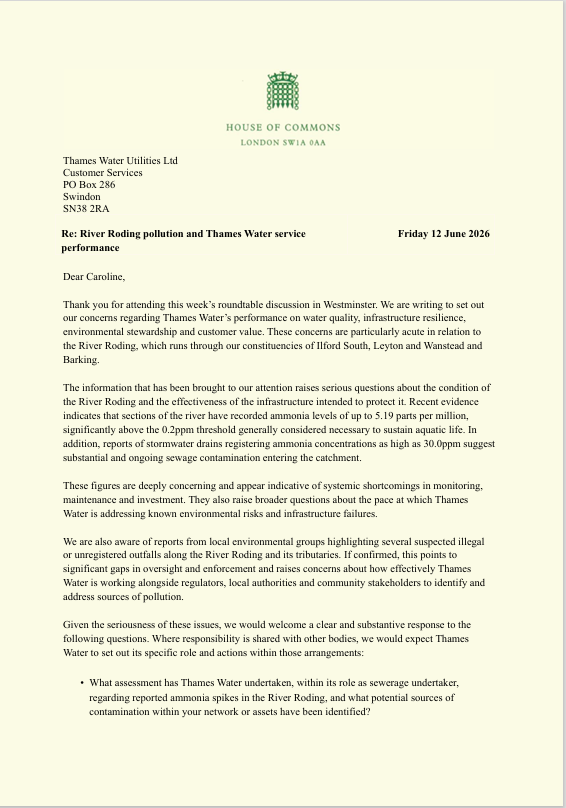
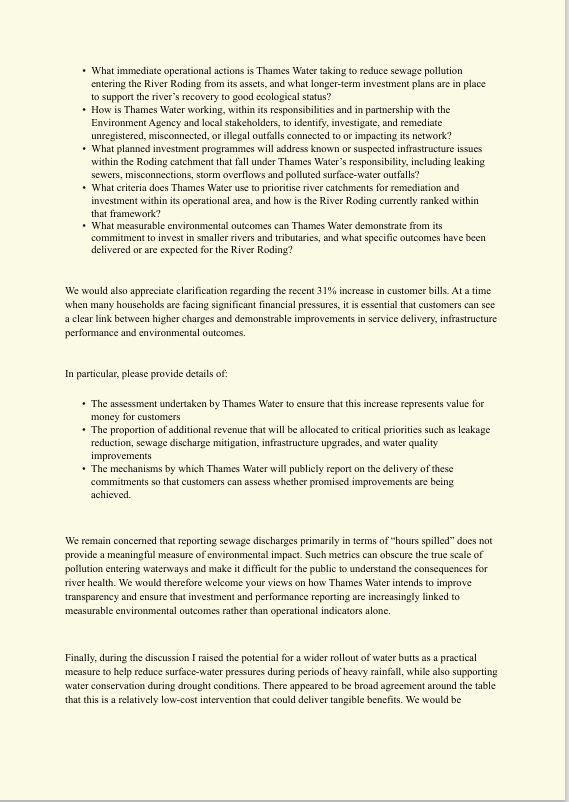
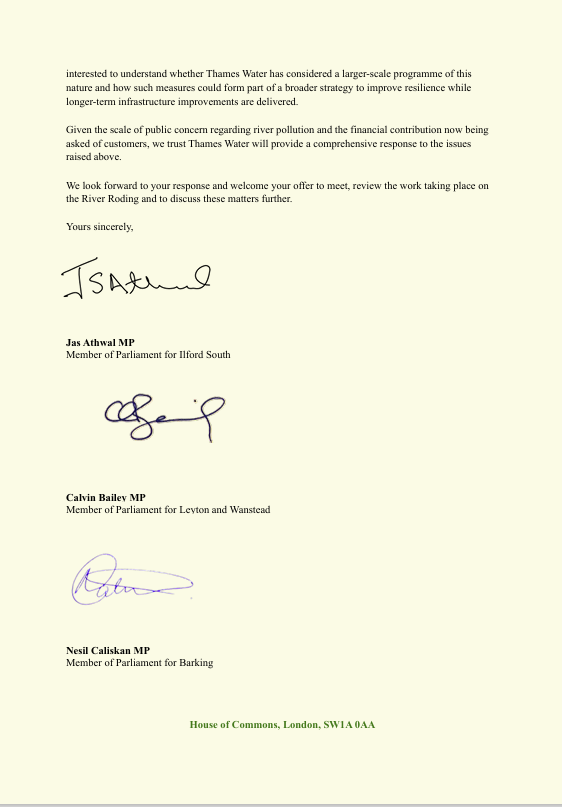
The Member of Parliament for Barking, Nesil Caliskan, has written to Thames Water, alongside local MPs Jas Atwal and Calvin Bailey, demanding urgent action to address growing concerns over continued pollution in the River Roding.
A major concern raised in the letter included reports of sewage discharge and elevated ammonia levels, which threaten local wildlife and community wellbeing.
“Recent evidence indicates that sections of the river recorded ammonia levels of up to 5.19 parts per million” nearly 26 times over “the levels considered necessary to sustain aquatic life.”
There are “reports of stormwater drains registering ammonia concentrations as high as 30.0ppm suggesting substantial and ongoing sewage contamination.”, Nesil Caliskan MP said.
In a meeting of the Environment Committee at the London Assembly last year, Paul Powlesland from the River Roding Trust, described his dismay at the sewage and the lack of coordination to tackle pollutants in London’s rivers. The issues raised, however, continue to persist.
Nesil Caliskan MP said:
“The levels of pollution in the water in Barking & Dagenham are disgusting. Local people in our borough deserve clean waterways not sewage. The River Roding Trust has been doing great work to clean up the Roding River, but ultimately Thames Water should be held to account and end this pollution.”
The MP emphasised the importance of protecting the borough’s waterways and called for greater transparency from Thames Water on pollution incidents, alongside a clear, time-bound plan to reduce them.
The MP has requested a prompt response and has indicated that they will continue to press the issue with regulators and government bodies if sufficient action is not taken.
New milestone for Holme Wood as Judith Cummins MP launches £20m Pride in Place programme’s Board
Judith Cummins (Bradford South)
STECHFORD LANE OPEN SPACE
Liam Byrne (Birmingham Hodge Hill and Solihull North)
The Installation of Rev. Jennifer Elizabeth Mayo
Wendy Morton (Aldridge-Brownhills)
It was a wonderful afternoon on Saturday as we celebrated the Licensing and installation of Reverend Jennifer Elizabeth Mayo as the new Priest-in-Charge at the Parish Church of St. Mark, Shelfield & High Heath.
I know just how long the local church and our wider community have been waiting for this moment, and the sheer joy and warmth in the room on Saturday showed exactly how much this means to everyone.
A massive, warm welcome to Reverend Jenny! We are absolutely thrilled to have you here, and I know our community is looking forward to supporting you and working alongside you in this exciting new chapter for St. Mark’s.
Statement on EHRC Guidance on Sex-Based Spaces
Bell Ribeiro-Addy (Clapham and Brixton Hill)

The Supreme Court ruling of April 2025 caused considerable fear and distress amongst transgender people living in the UK and their loved ones. I am acutely aware of the very real harm this climate is causing to individuals and their families. It is particularly alarming that there have been reports of trans people seeking to leave the UK as they no longer feel safe here.
I share concerns that the latest guidance from the Equalities and Human Rights Commission (EHRC) will only further harm and marginalise trans people and risks excluding them from facilities they have used without incident for a long time. The government’s own equality impact assessment acknowledges the widely negative impact it is likely to have on trans rights: from excluding trans people from facilities to outing them without consent and safeguarding risks for trans women forced to use men’s services.
It specifies that trans women should not be permitted to use women’s facilities in places such as hospitals, shops, and restaurants. It also stipulates that people may be asked to confirm their birth sex where a service provider considers it “necessary and proportionate” to do so. Requiring trans people to confirm their birth sex in this way is an unacceptable infringement of their human rights: in particular, their right to privacy and dignity.
I also worry about the broader consequences of this decision for AFAB women who may not conform to traditional notions of femininity. This guidance could have worrying implications for their dignity, public perception and safety.
Trans people deserve to live with the dignity, freedom and safety to participate fully in public life. This guidance represents a significant step away from this aspiration. I recently raised my concerns in Parliament around the EHRC proposals, the implications for trans people and the wider LGBTQ+ community and the need for trans-inclusive guidance on sex-based spaces.
I have signed Early Day Motion 240, aiming to disapprove the draft Code of Practice for Services, public functions and associations laid before the House of Commons on the 21st May. I have also added my name to Early Day Motion 1251, which recognises that transgender transition liberates trans people to be their true selves, condemns baseless fearmongering in the media, and calls on the Government to fulfil its statutory public sector equality duty to trans people.
I will continue to advocate firmly to ensure that trans people, and all members of the LGBTQ+ community, are able to participate fully in public life as their authentic selves, free from discrimination, and welcomed and respected accordingly.
The post Statement on EHRC Guidance on Sex-Based Spaces appeared first on Bell Ribeiro-Addy.
Vacancy: Constituency Support Officer
Dave Doogan (Angus and Perthshire Glens)
Healthy Start Scheme Bill
Emma Lewell-Buck (South Shields)
Healthy Start value was increased by 10% in April. It’s been a long campaign. I am continuing to work with Sustain: The Alliance For Better Food And Farming, The Food Foundation, Feeding Britain and the Department of Health and Social Care as we push for maximum take up.
The post Healthy Start Scheme Bill appeared first on Emma Lewell MP.
In Detail, In Brief: Ending the Feudal Leasehold System
Karin Smyth (Bristol South)
SEND Provision
Liz Twist (Blaydon and Consett)
March Update
Sean Woodcock (Banbury)
What I’ve been up to throughout March March has been a busy month, both in Westminster and in the constituency. In Westminster, a lot of my time has been spent on the Housing, Communities and Local Government Select Committee, where we have been doing pre-legislative scrutiny of commonhold and leasehold legislation. I asked constituents to
The post March Update appeared first on Sean Woodcock, MP for Banbury.
March Newsletter
Mohammad Yasin (Bedford)


The post March Newsletter appeared first on Mohammad Yasin MP.
World Refugee Day 2025: Celebrating Community and Inclusion with the First Ever World Refugee Day Cup Football Tournament in Dundee
Stephen Gethins (Arbroath and Broughty Ferry)
The Third Runway: A Monument to Mediocrity
Kit Malthouse (North West Hampshire)
An abridged version of this article ran in The Times on 3rd February 2025
In 2007, in the pages of this newspaper, I argued that Britain should seize the moment and move Heathrow to the Thames Estuary, freeing up the congested west London site for much-needed housing while creating a world-leading transport hub fit for the 21st century. It was an ambitious plan—perhaps too ambitious for a nation that has lost its appetite for grand infrastructure. Seventeen years later, what do we have? The same tired debates, the same dithering, and now, a third runway proposal that represents the absolute minimum of what could be done. It is not a vision; it is a concession to stagnation.
Throughout history, Britain built infrastructure that transformed cities and continents. The Victorians laid thousands of miles of railways across India and Africa. British engineers built the world’s first underground railway in London, the great docks of Hong Kong, and the vast shipping hubs that made global trade possible. Ours was once a nation that saw scale and complexity as challenges to be overcome, not reasons to prevaricate. Today, while China constructs floating airports in Hong Kong and Dalian, we are still arguing over a few extra miles of tarmac at an aging airport hemmed in by suburban sprawl.
The case for expanding Heathrow is undeniable. The airport operates at near capacity, with any disruption causing delays that ripple across the global aviation network. Additional capacity is needed. But the third runway is not a bold leap forward—it is an unimaginative compromise. The design is a relic of a bygone era when Britain was still willing to approve large infrastructure projects but had already begun its slow descent into cautious incrementalism. Surely for a solution we should be looking beyond the immediate horizon, daring to create something transformative.
Compare this to the grand infrastructure ambitions of Asia. Hong Kong’s Chek Lap Kok, which replaced the legendary but perilous Kai Tak airport in the 1990s, was built on reclaimed land. It was a marvel of engineering (mostly British), completed in just six years. Now, China is taking the concept even further: Dalian is constructing a floating airport, pushing the boundaries of what is possible. This is a country that doesn’t simply accept geographic limitations—it overcomes them. Britain, meanwhile, is paralysed by protest groups, endless consultations, and political hand-wringing.
A floating airport in the Thames Estuary—an idea proposed and swiftly dismissed—would have been a statement of ambition. London could have had its own Chek Lap Kok, a world-class hub unencumbered by the constraints of Heathrow’s location. Instead, we are left with a piecemeal expansion of an outdated site, in a project that will take decades and still leave Britain trailing behind.
The environmental argument against expansion is often cited as a reason for delay, but it is a red herring. Modern aviation is rapidly advancing towards lower emissions and greater efficiency. If the concern is air pollution and carbon footprints, the answer is not to stifle airport expansion but to embrace new technology, support cleaner aviation fuels, and invest in modern air traffic management. Britain should be leading these efforts, not using environmental concerns as an excuse for stagnation.
The economic cost of our hesitation is immense. Aviation is a key driver of trade, tourism, and investment. Heathrow’s constraints mean we lose out to European rivals, with airlines shifting long-haul routes to Paris, Amsterdam, and Frankfurt. The third runway, even if built, will do little to reclaim lost ground. By the time it is operational—assuming it even survives the judicial challenges that will inevitably come—other nations will have long since surpassed us.
What Britain needs is a fundamental shift in mindset. We must stop viewing major infrastructure projects as necessary evils to be endured and start treating them as national priorities. This requires reforming our planning laws, streamlining approval processes, and fostering a political culture that celebrates engineering excellence rather than recoiling from it.
The third runway at Heathrow is not the answer—it is a symptom of our decline. Instead of an afterthought tacked onto an aging airport, we should be considering radical alternatives: offshore airports, high-speed rail integration to regional hubs, and a renewed commitment to infrastructure that places Britain at the forefront of global connectivity. We were once a nation that built the world’s most advanced transport networks, that pioneered engineering breakthroughs others only dreamed of. We can be that nation again—but only if we stop settling for mediocrity and start daring to think bigger.
The world is not waiting for Britain to catch up. While we squabble over a single new runway, China is building entire new airports on water. The contrast is stark, and the lesson is clear: boldness breeds success, hesitation ensures decline. If Britain truly wishes to remain a global player, we must abandon the timid incrementalism of the third runway and embrace the kind of audacity that once made us great.
Kit Malthouse 1st February 2025
ICC FILES ARREST WARRANTS
Brendan O'Hara (Argyll, Bute and South Lochaber)
Toby Perkins MP supports Chesterfield Hedgehog Rescue and Rehabilitation
Toby Perkins (Chesterfield)
The post Toby Perkins MP supports Chesterfield Hedgehog Rescue and Rehabilitation appeared first on Toby Perkins Labour MP.